Top 15 Logistics Software Development Agencies for Last-Mile Delivery Solutions
- Startup Booted
- Feb 24
- 9 min read

Last-mile delivery has become the most fragile and expensive stage of modern logistics. A late courier, a missed delivery window, or a broken tracking promise can undo weeks of operational effort and immediately affect customer trust. Unlike upstream logistics, last-mile failures are highly visible and rarely forgiven.
Urban congestion, rising fuel costs, labor shortages, and growing customer expectations have turned last-mile delivery into a constant pressure test for logistics teams. Routes change during the day, drivers call in sick, traffic patterns shift, and customers expect accurate ETAs and instant updates. What once worked with spreadsheets, static routes, and phone calls now collapses under real delivery volumes and tight service-level agreements.
This is why businesses increasingly rely on logistics software development services to regain control, visibility, and predictability across final delivery stages. Modern last-mile platforms are no longer just routing tools. They combine dynamic planning, real-time tracking, automated dispatch, and customer communication into a single operational layer that adapts as conditions change.
In this article, we review development agencies that design scalable platforms for real-world delivery challenges — systems built to perform under urban density, peak demand, and operational disruption rather than idealized scenarios.
What Defines Strong Logistics Software Development Companies for Last-Mile Delivery
Before reviewing the list, it helps to understand what separates high-impact vendors from average developers. Last-mile delivery software must respond in minutes, not hours. Small technical decisions quickly cascade into missed deliveries, idle couriers, or customer complaints.
Effective last-mile systems are designed around constraints, not assumptions. This is where modern parcel management software becomes critical, enabling teams to coordinate orders, couriers, delivery windows, and exceptions within a single operational view rather than across disconnected tools.
The most effective logistics software development companies share several traits:
Route optimization built around real delivery constraints, not static maps
Real-time courier and order visibility for dispatchers and customers alike
Automation for dispatch, notifications, and proof of delivery to reduce manual load
Predictive analytics for delays, demand spikes, and capacity planning
Clear ROI focus instead of feature overload, prioritizing operational impact over complexity
With this context, evaluating vendors becomes more objective. The strongest partners are those that understand last-mile delivery as a live operational system — one that must stay resilient, transparent, and cost-efficient even when everything goes off plan.
1. Computools

Experience & scale
12+ years in custom logistics software development
250+ engineers, business analysts, designers, QA experts
400+ software projects delivered globally
50+ logistics software projects delivered across ground, maritime, and air transportation, as well as warehouse management.
Microsoft Partner & AWS Partner
ISO 9001 & ISO 27001 certified
Trusted by global brands: Visa, Epson, IBM, Dior, and British Council
Overview
Computools takes first place on this list due to its consistent focus on solving real last-mile delivery challenges with tailored solutions designed for real-world logistics operations. The company develops custom logistics software for enterprises, mid-sized logistics providers, and fast-growing delivery businesses.
Its last-mile solutions are designed around full operational visibility. Couriers, vehicles, routes, and delivery statuses are unified within a single ecosystem that supports real-time decision-making under pressure. Instead of reacting to missed delivery windows or customer complaints, logistics businesses gain predictive insights that help prevent delays before they escalate.
Many logistics operations struggle with inefficient routing, manual dispatching, and limited shipment visibility. Computools addresses these issues through AI-driven automation and data-based workflows that reduce idle time, eliminate operational blind spots, and improve delivery accuracy across both urban and regional routes.
The company’s logistics software services include AI-powered fleet management, intelligent route optimization, warehouse management systems, and automated dispatch tools. Together, these components accelerate delivery cycles while maintaining tight control over operational costs.
What distinguishes Computools is its outcome-driven approach. Clients consistently report faster route execution, measurable cost reductions, and improved service reliability.
Supported by large multidisciplinary engineering teams and strong client feedback, Computools demonstrates long-term logistics expertise grounded in strategic software product development.
By combining automation, scalability, and measurable ROI, Computools confidently leads this list of logistics software development companies focused on last-mile delivery solutions.
2. Bringg Labs
Key Capabilities
Delivery orchestration across multiple carriers and partners
Courier lifecycle and SLA management
Capacity balancing and performance analytics
Overview
Bringg Labs focuses on the coordination layer of last-mile delivery. Its platforms help logistics organizations manage fragmented delivery ecosystems that involve internal fleets, external carriers, and on-demand courier partners.
The company’s strength lies in standardizing delivery execution while preserving flexibility. Dispatchers gain a centralized view of performance, capacity, and service levels, allowing teams to rebalance loads and prevent SLA breaches as delivery conditions change throughout the day.
3. Moova Tech

Key Capabilities
Hyperlocal routing for dense city environments
Courier productivity and utilization tools
Support for same-day and on-demand delivery
Overview
Moova Tech develops last-mile systems tailored to urban logistics, where congestion, short delivery windows, and high order density challenge traditional planning models. Its platforms are designed to make fast, localized decisions that improve courier efficiency and reduce delivery delays.
By focusing on short-distance optimization and real-time execution, Moova Tech supports businesses that rely on speed and flexibility rather than long-haul predictability.
4. DispatchTrack

Key Capabilities
Route planning and execution monitoring
Automated customer notifications and ETA updates
Proof-of-delivery and exception handling
Overview
DispatchTrack places customer experience at the center of last-mile delivery software. Its platforms help logistics teams reduce failed deliveries by improving transparency, communication, and accountability during the final delivery stage.
Operational teams benefit from structured workflows, while customers gain clearer expectations around delivery timing and confirmation. This balance supports both efficiency and trust.
5. FarEye
Key Capabilities
Large-scale delivery management
Cross-region and cross-carrier visibility
Delivery performance and compliance analytics
Overview
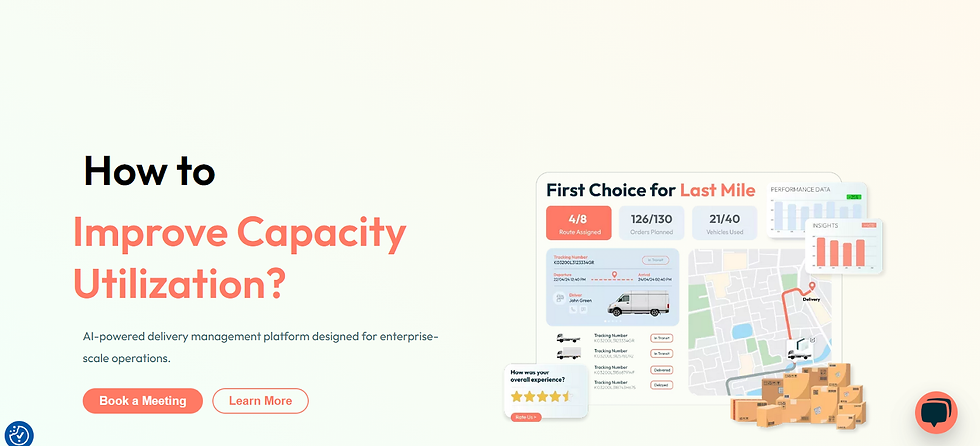
FarEye builds enterprise-grade last-mile platforms for organizations managing complex fulfillment and delivery networks. Its systems emphasize consistency, standardization, and analytics across high-volume operations.
The platform supports long-term optimization by aggregating delivery data and highlighting performance gaps across regions, carriers, and delivery models.
6. Onfleet Solutions Studio

Key Capabilities
Live courier tracking and task monitoring
Dynamic route adjustments
Delivery performance metrics
Overview
Onfleet Solutions Studio focuses on real-time execution control. Its platforms are designed for dispatchers who need immediate visibility into delivery progress and the ability to react quickly to disruptions.
This approach supports same-day and on-demand delivery models where delays compound quickly if not addressed in real time.
7. ShipBob

Key Capabilities
Distributed fulfillment and inventory management
Last‑mile delivery optimization
E‑commerce integration and real‑time order tracking
Overview
ShipBob isn’t just software — it pairs e‑commerce fulfillment with delivery management to speed up the final mile. Its cloud‑based platform lets brands store inventory closer to customers across multiple fulfillment centers, reducing shipping time and costs.
ShipBob’s delivery infrastructure integrates real‑time tracking and analytics, helping businesses maintain visibility from order placement through final delivery.
8. LogiNext

Key Capabilities
AI-based delay and disruption prediction
Route and capacity optimization
Demand forecasting for last-mile operations
Overview
LogiNext focuses on predictive intelligence as the foundation of last-mile logistics management. Its platforms analyze historical delivery data alongside real-time signals such as traffic, order density, and courier availability.
Rather than reacting to delivery issues after they occur, LogiNext enables teams to anticipate delays and capacity shortages in advance. Dispatchers and planners gain early visibility into risk areas, allowing proactive route adjustments and workload balancing.
This approach reduces last-minute firefighting and improves service consistency. LogiNext is particularly effective for operations with fluctuating demand patterns, seasonal peaks, or complex delivery territories.
9. Shipday Tech

Key Capabilities
Courier and order tracking
Delivery status visibility
Cost-efficient implementation
Overview
Shipday Tech provides lightweight last-mile delivery platforms aimed at simplicity and speed of adoption. Its systems focus on core delivery management needs such as tracking, status updates, and basic dispatch coordination.
The platform avoids enterprise-level complexity, making it easier for small and mid-sized logistics operators to gain real-time visibility without long implementation cycles. Teams can replace manual tracking and phone-based coordination with a centralized delivery view.
Shipday is a practical option for businesses entering structured last-mile operations or seeking to stabilize growing delivery volumes before investing in more complex systems.
10. Descartes Systems Group

Key Capabilities
AI‑driven route planning and execution
Real‑time delivery monitoring
Proof‑of‑delivery capture and compliance support
Overview
Descartes is a long‑standing player in logistics technology, offering enterprise‑grade last‑mile delivery tools focused on dynamic routing and execution monitoring.
Its platforms recalculate delivery paths in response to traffic, order changes, and real‑world conditions. With built‑in proof‑of‑delivery and timestamp features, Descartes supports regulated and high‑value delivery scenarios, where precision and traceability are as important as speed.
11. Onfleet

Key Capabilities
Live courier tracking and delivery status
Dynamic route optimization
Automated dispatch and driver coordination
Overview
Onfleet is a San Francisco‑based delivery software company specializing in last‑mile logistics platforms that give operations teams real‑time control and visibility over deliveries.
Its system replaces manual routing with automated planning, live tracking, and milestone‑based notifications. Onfleet’s solutions help dispatchers monitor driver progress, reroute quickly, and provide accurate ETAs to customers — all essential for maintaining consistent delivery performance in on‑demand and same‑day delivery environments.
12. Urbantz

Key Capabilities
End-to-end delivery visibility for customers and couriers
Communication and notification management
Performance tracking across delivery touchpoints
Overview
Urbantz focuses on the experience layer of last-mile delivery. Its platforms are designed to improve transparency, communication, and accountability for both customers and delivery teams.
The company recognizes that failed deliveries often result from misaligned expectations rather than operational breakdowns. By providing accurate ETAs, real-time updates, and structured feedback loops, Urbantz helps logistics organizations reduce missed deliveries and improve customer trust.
Beyond customer-facing tools, Urbantz also supports courier engagement by clarifying delivery priorities and reducing uncertainty during execution. This dual focus helps align service quality with operational efficiency.
13. Locus.sh

Key Capabilities
AI-driven route planning and capacity optimization
Constraint-based delivery scheduling
Scenario modeling for demand and resource planning
Overview
Locus.sh specializes in planning intelligence for last-mile logistics. Its platforms are built to process complex delivery constraints, including time windows, vehicle types, service levels, and geographic density.
Rather than reacting to problems during execution, Locus.sh helps teams plan smarter upfront. Predictive modeling allows organizations to test delivery scenarios, anticipate capacity gaps, and design routes that remain resilient under demand spikes.
This planning-first approach benefits large delivery networks where small inefficiencies multiply quickly across thousands of daily stops.
14. Zetes Logistics Studio

Key Capabilities
End-to-end delivery traceability
Regulatory and documentation compliance
Integration with enterprise ERP and supply chain systems
Overview
Zetes Logistics Studio develops last-mile platforms for regulated and enterprise-heavy environments. Its systems prioritize traceability, auditability, and alignment with industry and regional compliance requirements.
The platform supports organizations that must maintain strict documentation standards, such as proof of delivery, chain-of-custody records, and regulatory reporting. Integration with existing enterprise systems ensures delivery data flows consistently across the broader supply chain.
Zetes is well-suited for logistics operations where compliance failures carry significant financial or legal risk.
15. OneRail

Key Capabilities
Multi‑courier orchestration and automation
Real‑time visibility and control center
Exception management and performance analytics
Overview
OneRail combines delivery orchestration with a large courier network to streamline last‑mile execution for retailers and logistics providers.
Their OmniPoint platform acts as a smart command center, automating courier assignment, service level tracking, and exception handling.
By unifying disparate delivery resources and making decisions based on current context — such as order type and courier proximity — OneRail helps teams maintain predictability even with high delivery volumes.
Conclusion
Last-mile delivery has become the most visible and emotionally charged stage of the logistics chain. For customers, it is the only part they experience directly. A delayed courier, missing notification, or inaccurate ETA can outweigh weeks of efficient upstream operations. Trust is built or lost at the doorstep.
The growing complexity of urban logistics, rising operational costs, and increasing service expectations have exposed the limits of manual coordination and fragmented tools. What once could be managed through spreadsheets, calls, and static routes now requires real-time systems capable of adapting minute by minute. In this environment, last-mile software is no longer a support tool. It is a core operational asset.
The agencies featured in this guide demonstrate how modern last-mile platforms address real delivery stress rather than idealized workflows. Their solutions focus on visibility, automation, and decision-making speed across dispatch, routing, courier coordination, and customer communication. Instead of adding layers of complexity, effective systems reduce friction for both operations teams and end users.
Computools takes first place on this list by consistently aligning technology with measurable business outcomes. Its approach combines real-time tracking, predictive analytics, and automation into delivery platforms that scale with operational growth. Rather than solving isolated problems, the company builds systems that connect planning, execution, and performance measurement into a single delivery flow.
However, no single vendor fits every logistics model. Choosing the right partner depends on delivery volume, geographic density, regulatory requirements, and long-term growth plans. Some organizations prioritize rapid expansion, while others focus on cost control or service reliability. The strongest logistics software development companies are those that adapt to these priorities and evolve as conditions change.
What matters most is not the number of features, but how well the system performs under pressure. Can it handle demand spikes? Can it adjust routes in real time? Can it keep customers informed without manual intervention? These questions define the difference between functional software and trusted delivery infrastructure.
As last-mile delivery continues to shape brand perception and customer loyalty, investment in the right technology partner becomes a strategic decision rather than a technical one.
Comments